
Por una antropología de la mirada: Etnografía, representación y construcción de datos audiovisuales
DOI:
https://doi.org/10.56247/qua.573Palabras clave:
Antropología visual, cine etnográfico, representación, metodología, datos audiovisualesResumen
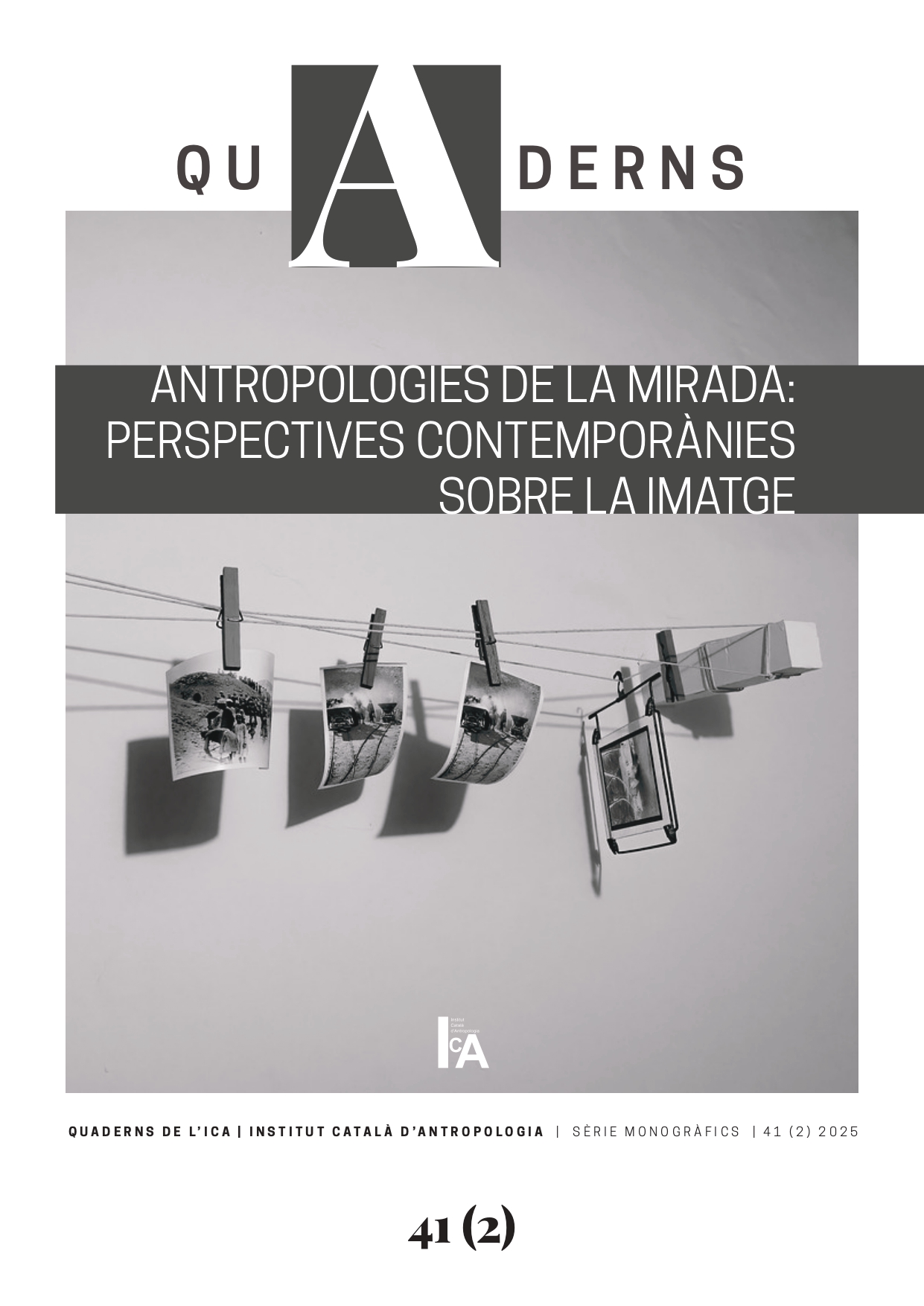
Este artículo propone una reflexión teórica y metodológica sobre el papel de la imagen en la investigación antropológica. Publicado por primera vez en la Revista de Dialectología y Tradiciones Populares (CSIC, 1998), el texto reflexiona sobre el papel de la imagen en la investigación antropológica y defiende la antropología visual como un campo abierto a la experimentación. La autora analiza la doble dimensión de la imagen como dato etnográfico y como representación cultural, revisando las contribuciones de Mead, Bateson, Rouch o MacDougall, entre otros. Ardèvol propone distinguir entre el cine etnográfico documental y el cine exploratorio, que integra la cámara en el proceso de investigación y reconoce su carácter relacional y performativo. También critica los «trucos» del cine observacional y defiende una antropología compartida, donde la producción audiovisual forma parte de la construcción colectiva del conocimiento y de la reflexión crítica sobre la mirada etnográfica.
Descargas
Estadísticas globales ℹ️
|
545
Visualizaciones
|
278
Descargas
|
|
823
Total
|
|
Citas
Ardèvol, E., & Pérez-Tolón, L. (Eds.). (1995). Imagen y cultura: Perspectivas del cine etnográfico (Biblioteca de Etnología, núm. 3). Diputación Provincial de Granada.
Ardèvol, E. (1997). Representación y cine etnográfico. Quaderns de l’ICA, (10).
Ardèvol, E. (1998). Esto no es una película: Etnografía y construcción de datos audiovisuales En E. Bodelón & T. Picontó (Eds.), Jóvenes sociólogos del derecho. Instituto Internacional de Sociología Jurídica. (En prensa).
Ardèvol, E. (1998, abril). La construcción de la mirada en The Ax Fight. Secuencias. Revista de Historia del Cine.
Asch, T., Marshall, J., & Spier, P. (1973). Ethnographic film: Structure and function. Annual Review of Anthropology, (2). DOI: https://doi.org/10.1146/annurev.an.02.100173.001143
Asch, T. (1975). Using film in teaching anthropology: One pedagogical approach. En P. Hockings (Ed.), Principles of visual anthropology. Mouton. DOI: https://doi.org/10.1515/9783112415405-027
Asch, T., & Asch, P. (1988). Film in anthropological research. Senri Ethnological Studies, (24).
Barnouw, E. (1974). Documentary: A history of the non-fiction film. Oxford University Press.
Bateson, G., & Mead, M. (1977). Margaret Mead and Gregory Bateson on the use of the camera in anthropology. Studies in the Anthropology of Visual Communication, 4(2), Winter. (Extracto de For God’s Sake, Margaret: Conversation with G. Bateson and M. Mead. The CoEvolution Quarterly, 10/21, 1976). DOI: https://doi.org/10.1525/var.1977.4.2.78
Bhabha, H. K. (1983). The other question... Homi K. Bhabha reconsiders the stereotype and colonial discourse. Screen, 8(6), November–December. DOI: https://doi.org/10.1093/screen/24.6.18
Birdwhistell, R. L. (1973). Kinesics and context: Essays on body-motion communication. Penguin Books.
Clifford, J., & Marcus, G. (1986). Writing culture. University of California Press. (Versión castellana: Retóricas de la antropología. Ed. Júcar, 1991). DOI: https://doi.org/10.1525/9780520946286
Colleyn, J.-P. (1992). Il faut décloisonner le genre! CinemAction, (64), 3tr.
Connor, L., Asch, T., & Asch, P. (1986). Jero Tapakan: Balinese healer. Cambridge University Press.
Crawford, P. I., & Simonsen, J. K. (Eds.). (1992). Ethnographic film aesthetics and narrative traditions: Proceedings from NAFA 2. Intervention Press.
Crawford, P. I., & Turton, D. (Eds.). (1992). Film as ethnography. Manchester University Press.
Chiozzi, P. (Ed.). (1989). An experience in teaching visual anthropology in Italian high schools.
En P. Chiozzi (Ed.), Teaching visual anthropology. European Association for Visual Studies of Man.
De Brigard, E. (1975). The history of ethnographic film. En P. Hockings (Ed.), Principles of visual anthropology. Mouton Publishers. DOI: https://doi.org/10.1515/9783112415405-004
De France, C. (1989). Cinéma et anthropologie (Ed. revisada). Fondation de la Maison des Sciences de l’Homme. DOI: https://doi.org/10.4000/books.editionsmsh.6198
De Heusch, L. (1993). El nacimiento del cine documental sociológico en Europa. Fundamentos de Antropología.
Duranti, A. (1997). Linguistic anthropology. Cambridge University Press. DOI: https://doi.org/10.1017/CBO9780511810190
Eaton, M. (Ed.). (1979). Anthropology–Reality–Cinema: The films of Jean Rouch. British Film Institute.
Eco, U. (1979). The role of the reader. Indiana University Press. DOI: https://doi.org/10.2979/2846.0
Eco, U. (1990). The limits of interpretation. Indiana University Press. DOI: https://doi.org/10.2979/2229.0
Ferrándiz, F. (1997). A trace of fingerprints: Displacements and textures in the use of ethnographic video in Venezuelan spiritism. Visual Anthropology Review, 13(2), 19–38. DOI: https://doi.org/10.1525/var.1997.13.2.19
Feld, S. (1989). Themes in the cinema of Jean Rouch. Visual Anthropology, 2. DOI: https://doi.org/10.1080/08949468.1989.9966512
Garrido, J. A. (1993). Antropologia i cinema. L’Avenç, (174).
Geertz, C. (1987). La interpretación de las culturas (Ed. orig. 1973). Gedisa.
Gross, L., Katz, J. S., & Ruby, J. (Eds.). (1988). Image ethics: The moral rights of subjects in photographs, film and television. Oxford University Press.
Gurevitch, M., Bennett, T., Curran, J., & Woolacott, J. (1982). Culture, society and the media. Methuen.
Heider, K. G. (1972). Films for anthropological teaching. Program in Ethnographic Film.
Hockings, P. (Ed.). (1975). Principles of visual anthropology. Mouton Publishers. DOI: https://doi.org/10.1515/9783112415405
Hockings, P. (1988). Ethnographic filming and the development of anthropological theory. En P.
Hockings & Y. Omori (Eds.), Cinematographic theory and new directions in ethnographic film. University of Illinois Press.
Lison Arcal, J. C. (1993, marzo). Antropología visual: Un campo abierto. Sociedad y Utopía, (1).
Loizos, P. (1993). Innovation in ethnographic film: From innocence to self-consciousness, 1955–1985. Manchester University Press.
López Izquierdo, M., & Ventosa, S. (1990). El documento fílmico en la antropología visual. En II Congreso de Folclore Andaluz, Sevilla.
MacDougall, D. (1975). Beyond observational cinema. En P. Hockings (Ed.), Principles of visual anthropology. Mouton Publishers. DOI: https://doi.org/10.1515/9783112415405-009
MacDougall, D. (1992). Whose story is it? En P. I. Crawford & J. K. Simonsen (Eds.), Ethnographic film aesthetics and narrative traditions: Proceedings from NAFA 2. Intervention Press. (Versión castellana en Ardèvol, E. & Pérez-Tolón, L. (Eds.), Imagen y cultura. Diputación Provincial de Granada, 1995).
Marcus, G. E., & Fisher, M. M. J. (1986). Anthropology as cultural critique: An experimental moment in the human sciences. University of Chicago Press.
Marcus, G. E. (1990, spring). The modernist sensibility in recent ethnographic writing and the cinematic metaphor of montage. Visual Anthropology Review. DOI: https://doi.org/10.1525/var.1990.6.1.2
Martínez, W. (1987, November 1). The visual translation of cultures: Exploring the use of film in teaching anthropology. American Anthropological Association Meeting, Chicago.
Martínez, W. (1990, spring). Critical studies and visual anthropology: Aberrant versus anticipated readings of ethnographic film. Commission for Visual Anthropology Review (CVA).
Martínez, W. (1992). Who constructs anthropological knowledge? Toward a theory of ethnographic film spectatorship. En P. I. Crawford & D. Turton (Eds.), Film as ethnography. University of Manchester Press.
Morley, D. (1980). The “Nationwide” audience: Structure and decoding. British Film Institute.
Renov, M. (1986). Rethinking documentary. Wide Angle, 8(3–4).
Rollwagen, J. R. (Ed.). (1988). Anthropological filmmaking. Harwood Academic Publishers.
Rollwagen, J. R. (Ed.). (1993). Anthropological film and video in the 1990s. The Institute, Inc.
Rouch, J. (1975). The camera and man. En P. Hockings (Ed.), Principles of visual anthropology. Mouton Publishers. DOI: https://doi.org/10.1515/9783112415405-007
Ruby, J. (1975). Is an ethnographic film a filmic ethnography? Studies in the Anthropology of Visual Communication, 2(2). DOI: https://doi.org/10.1525/var.1975.2.2.104
Ruby, J. (1980). Exposing yourself: Reflexivity, anthropology and film. Semiotica, (3). DOI: https://doi.org/10.1515/semi.1980.30.1-2.153
Said, E. (1989). Representing the colonized: Anthropology’s interlocutors. Critical Inquiry, (15). University of Chicago Press. DOI: https://doi.org/10.1086/448481
Stoller, P. (1992). The cinematic griot: The ethnography of Jean Rouch. University of Chicago Press.
Turner, V. (1987). The anthropology of performance. PAJ Publications.
Varios autores. (1989, novembre). Imatges de l’altre al cinema. Correu de la UNESCO, XII(138).
Varios autores. (1993). Antropología visual [Número especial]. Antropológicas. UNAM.
Winston, B. (1988). Direct cinema: The third decade. En A. Rosenthal (Ed.), New challenges for documentary. University of California Press.
Worth, S. (1981). Studying visual communication (L. Gross, Ed.). University of Pennsylvania Press. DOI: https://doi.org/10.9783/9781512809282
Young, C. (1975). Observational cinema. En P. Hockings (Ed.), Principles of visual anthropology. Mouton Publishers.
Descargas
Publicado
Cómo citar
Número
Sección
Licencia
Derechos de autor 2025 Quaderns de l'Institut Català d'Antropologia

Esta obra está bajo una licencia internacional Creative Commons Atribución-NoComercial-CompartirIgual 4.0.
Distribuït sota els termes de la llicència d’ús i distribució Creative Commons Reconeixement 4.0 Internacional (CC BY-NC-SA 4.0)